
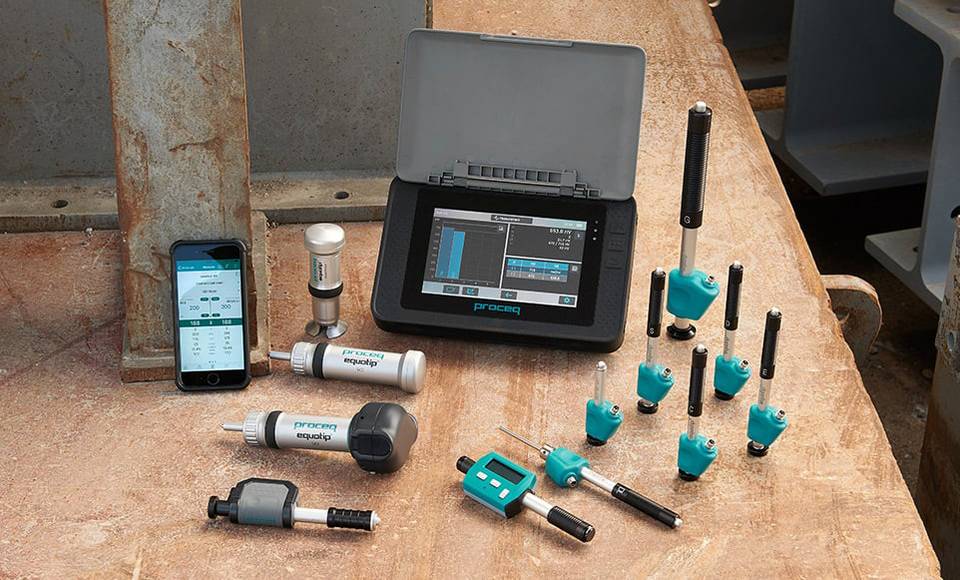
Equotip 550
Portable Hardness Tester
Abbey Spares are the UK’s largest officially approved Proceq reseller for the supply, sales, rental, service, repair and calibration of Proceq’ s range of Metal, Paper/Film and Concrete test instruments to an authorised procedure. Our factory trained staff have attained Proceq’ s Premier Service Centre status.
Proceq S. A. of Switzerland takes its name from “Process and Equipments” and was established in 1954. Initially concentrating on developing appliances for the pre-stressed concrete market, it has expanded into the specialist field of modern construction engineering, metering and testing techniques.
Proceq itself has accreditation to ISO9001 and Equotip 550 Leeb which conforms to ASTM A 956-06 and DIN 50156
The range of instruments includes Equotip 550 Leeb, Portable Metal Hardness Testers, Schmidt the Original Swiss Rebound Hammer for testing compressive strength of concrete, Profometer PM-600 rebar locator and a comprehensive range of concrete test instruments including the Pundit Ultrasonic Instrument, Parotester (Equotip Leeb U) Roll Hardness Tester and the PaperSchmidt for paper, film and foil industries.
Proceq S. A. of Switzerland takes its name from “Process and Equipments” and was established in 1954. Initially concentrating on developing appliances for the pre-stressed concrete market, it
has expanded into the specialist field of modern construction engineering, metering and testing techniques.
Contact Phill Mckenzie for further information and pricing.
Tel: 01905 621666 email:sales@abbeyspares.co.uk
Proceq – Bringing you over 60 years of know how
Proceq Service and Calibration of Instruments
UK's Only Premier Proceq Service CentreAbbey Spares and Supplies Ltd
As the UK’s only Proceq Premier Service Center, we offer a return to base, annual service and calibration check on the metal and concrete testing range. We will supply a UKAS traceable certificate for the Equotip and for the Schmidt Hammer and Profometer we can calibrate the equipment against a known standards held by the manufacturers.
We aim to offer a same day service and our hire fleet is available at an extra charge if you cannot be without your equipment whilst in for service and calibration.
Proceq Hire Equipment
We carry a fleet of instruments for hire and demonstration. Please ring for the latest stock and weekly rates.
UK based suppliers of hardness and non destructive testing equipment for hire of Equotip Hire, Piccolo Hire, Profoscope Hire, Schmidt Hammer Hire, UPV Hire, Pundit Hire, Resistivity Hire, Resipod Hire, Parotester Hire
- Equotip 550 Leeb Hardness Tester Hire
- Piccolo Hardness Tester Hire
- Schmidt Concrete Test Hammer Hire
- Schmidt OS120 PT and PM Pendulum Hammers
- SilverSchmidt Concrete Test Hammer Hire
- Parotester Roll Hardness Hire
- Resipod Resistivity Hire
- Pundit 250 Array Live Hire
- Profoscope Covermeter Rebar Locator Hire
- SACP Mexe Cone Soil Assessment Cone Penetrometer